Get a Free Quote
 4008-693-698
中文版
 4008-693-698
中文版
 2026-10-17 09:49:14
In modern buildings, industrial plants and equipment foundation works, structural vibration control is a key measure to enhance indoor comfort and operational stability of equipment. The operation of mechanical machinery, human activities and other dynamic loads can trigger structural vibration, which transmits to adjacent spaces via floor slabs, beams, columns and other connected members.
A floating floor system minimizes direct vibration transfer between structures by installing elastic supports or vibration isolation layers between the load-bearing substrate and the upper floor assembly. Compared with conventional rigid connections, a well-designed floating floor can alter the dynamic properties of the system to achieve the targeted vibration isolation performance.
Material selection for vibration damping is especially vital within this system. Polyurethane vibration isolation blocks possess tailorable elasticity, load-bearing capacity and mechanical properties of materials. They can act as elastic supporting elements for floating floor systems and provide vibration mitigation solutions for diverse engineering applications.
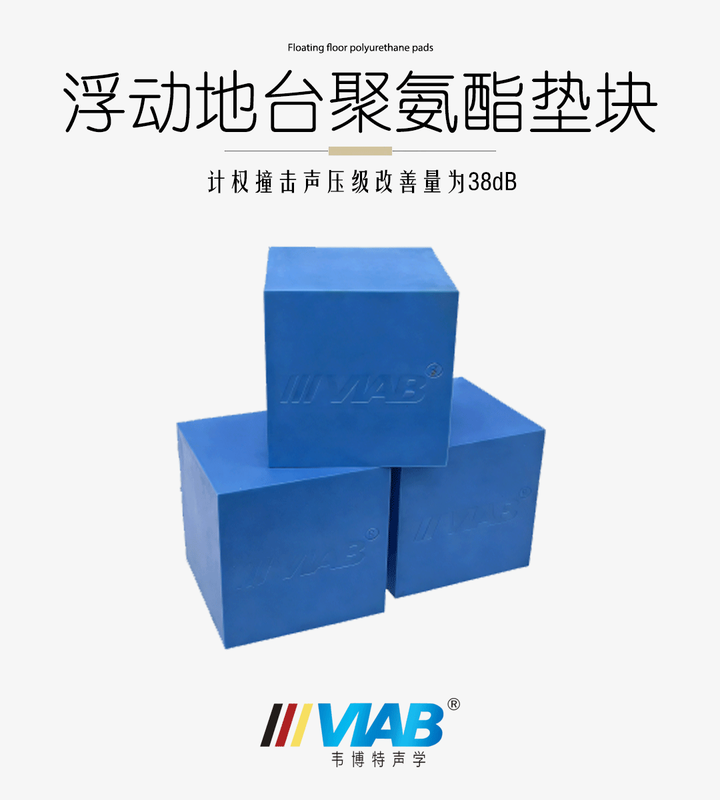
Polyurethane vibration isolation blocks are generally placed between the load-bearing substrate and the floating structure to control the transmission of vibration energy through the material’s elastic deformation and damping properties. Their vibration isolation performance is closely related to material formulation, geometric dimensions, stress state and overall system design.
From a dynamic perspective, a floating floor can be approximated as a vibration system consisting of mass, elastic supports and damping. Proper matching between the dynamic stiffness of vibration isolation blocks and the mass of the superstructure helps tune the natural frequency of the system and achieve vibration isolation within the appropriate excitation frequency range.
Therefore, the selection of polyurethane vibration isolation blocks cannot be judged merely by appearance, thickness or material hardness. It also requires comprehensive consideration of load-bearing capacity, compressive deformation, dynamic stiffness, damping performance and long-term service conditions. For projects with different loads and vibration frequencies, technical evaluation shall be carried out according to actual working conditions.
Polyurethane is a type of polymer material with highly tailorable performance, whose mechanical properties can be adjusted to meet specific application requirements. When used for vibration isolation blocks, its main benefits are reflected in the following aspects:
It should be noted that the inherent material performance does not equal the vibration isolation effect of the whole system. The actual performance still depends on system design, installation method and site working conditions.

In the design of floating floor systems, proper product selection is an important prerequisite to achieve the intended vibration isolation performance. Engineers shall focus on the following factors:
For projects with defined vibration isolation targets, comprehensive evaluation based on product datasheets, relevant test data and engineering calculations is recommended. Product selection shall not rely solely on material names or single parameters.
Within floating floor systems, vibration isolation materials govern not only elastic support performance but also the design and construction of the overall structure. Selecting a supplier with experience in material R&D, manufacturing and engineering application helps streamline product selection and procurement for projects.
Guangdong VIAB Acoustic Technology Co., Ltd. specializes in the R&D, production and engineering application of building acoustic materials and floating slab products. Catering to building sound insulation and vibration control demands, VIAB has established a product supply portfolio covering polyurethane sound insulation mats, polyurethane-rubber composite sound insulation mats, rubber sound insulation mats and more, providing tailored material selections for various engineering projects.
To meet vibration mitigation requirements of floating floor systems, engineering clients may review polyurethane vibration isolation blocks on VIAB’s official website and assess their suitability against project design loads, support conditions, installation methods and performance criteria. For projects requiring custom specifications or special engineering applications, further discussions with the manufacturer on product parameters and supporting requirements are available.
For developers, construction contractors, architectural design institutes and construction material purchasers, clarifying service conditions and technical indicators in advance and maintaining full communication with material suppliers helps reduce selection errors and improve compatibility between materials and engineering solutions.

The vibration isolation performance of a floating floor system relies on well-conceived structural design and properly matched elastic support materials. As a critical component within the system, polyurethane vibration isolation blocks require comprehensive evaluation of their material properties, load-bearing capacity and dynamic characteristics in accordance with actual site conditions.
If you are sourcing polyurethane vibration isolation blocks for floating floor systems, please visit the official website of Guangdong VIAB Acoustic Technology Co., Ltd. (VIAB Acoustic) for further product information. You may consult our team regarding product selection and technical support based on your specific project requirements.
VIAB Acoustic — Specialized in building acoustic materials, delivering professional material selection and supply support for engineering projects.

Contact Person: Manager He 13556110648
Address: Room 5022, No. 228 Qiaotou Street, Haizhu District, Guangzhou
 Scan QR Code for WeChat Consultation